Evaluating Summer Beach Ocean Waves Background for Professional Design Projects
Visual assets serve as the foundation of effective digital communication, particularly when conveying specific moods or seasonal themes. The Summer Beach Ocean Waves Background collection addresses a common challenge for designers and content creators: sourcing high-quality, thematic imagery that maintains professional standards across various media. Unlike generic stock photography, this curated set of digital papers offers stylized textures specifically engineered for layering, compositing, and background use. For professionals managing tight deadlines or hobbyists seeking consistent aesthetics, understanding the technical specifications and practical applications of these assets is essential before integration into a workflow.
Technical Specifications and Print Readiness
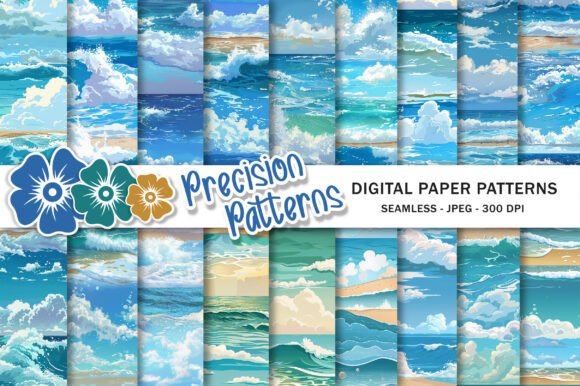
The primary metric for evaluating any digital design asset is its technical viability across different output formats. This collection includes 18 unique digital papers delivered in JPEG format at a resolution of 300 DPI (dots per inch). This specification is significant because it bridges the gap between screen-based design and physical printing. While 72 DPI suffices for web graphics, 300 DPI ensures that ink saturation and detail remain crisp when printed on cardstock, packaging, or photo paper. The 12″ x 12″ dimensions provide a standard square canvas that aligns with traditional scrapbooking standards while offering sufficient pixel density to be cropped or resized for smaller formats without degradation.
Professionals should note that JPEG files, while universally compatible, are raster-based. This means they do not scale infinitely like vector graphics. However, starting at 3600 x 3600 pixels provides ample headroom for most commercial and personal projects. When resizing these Summer Beach Ocean Waves Background files for social media banners or website headers, using bicubic sharper reduction algorithms in software like Photoshop or Affinity Photo will preserve edge definition better than standard resampling methods. The immediate download availability further supports agile workflows, eliminating wait times associated with physical shipping or complex licensing approvals.
Versatility Across Digital and Physical Media
The true value of a background pack lies in its adaptability. These ocean wave textures are designed with negative space and tonal variation in mind, making them functional rather than merely decorative. In graphic design, backgrounds often compete with foreground elements for attention. A well-designed Summer Beach Ocean Waves Background provides atmospheric context without overwhelming typography or product photography. The textural quality allows for easy blending modes; setting a layer to "Multiply" or "Overlay" can impart a coastal feel to solid color blocks or composite images without requiring complex masking.
For digital applications, these assets perform reliably as website hero sections, blog post dividers, or social media templates. The consistent color grading across all 18 files ensures brand cohesion when creating a series of posts or a multi-page digital planner. In physical applications, such as wedding invitations or birth announcements, the 300 DPI resolution ensures that subtle gradients in the water and sand textures reproduce smoothly, avoiding the banding artifacts often seen in lower-resolution beach imagery. Packaging designers may find the square format particularly useful for creating seamless patterns or wrapping small retail boxes where a continuous visual theme enhances perceived value.
Practical Applications for Specific User Groups
- Event Planners and Stationers: Ideal for destination wedding suites or summer party invitations where texture adds tactile interest to flat prints.
- Digital Product Creators: Useful for designing covers for e-books, journals, or printable planners that require a cohesive seasonal aesthetic.
- Social Media Managers: Provides instant, on-brand backdrops for quote cards, promotional announcements, or story highlights during summer campaigns.
- Educators and Homeschoolers: Suitable for creating engaging worksheets, lesson plan covers, or classroom decor with a calming, nature-inspired theme.
- Scrapbookers and Memory Keepers: Offers acid-free digital alternatives to physical paper, allowing for non-destructive editing and unlimited reprints of cherished layouts.
Workflow Integration and Software Compatibility
Compatibility determines whether an asset becomes a helpful tool or a frustrating obstacle. Because these files are standard JPEGs, they integrate seamlessly into virtually every major design ecosystem. Adobe Creative Cloud users, Canva designers, Procreate illustrators, and GIMP enthusiasts can all utilize the Summer Beach Ocean Waves Background without conversion issues. This universality is crucial for collaborative environments where team members may use different software stacks.
When incorporating these backgrounds into complex compositions, consider the file size management. High-resolution JPEGs can increase project file sizes significantly. Professionals working on large-scale print projects should link these files rather than embedding them when possible, or use smart objects to maintain editability. For web designers, exporting final compositions in modern formats like WebP or AVIF will retain the visual fidelity of the ocean textures while optimizing load times. The ease of resizing mentioned in the product details is accurate, provided users understand their software’s interpolation settings. Cropping a 12x12 image to a 4x6 postcard size actually increases the effective PPI, resulting in exceptionally sharp prints.
Assessing Quality and Long-Term Value
Beyond technical specs, the artistic merit and consistency of the collection determine its shelf life. Generic beach photos often suffer from oversaturation or inconsistent lighting, making them difficult to pair with other elements. This set appears curated for design utility, meaning the wave patterns and color palettes likely harmonize across the entire 18-file set. This internal consistency is vital for professionals who need to create matching collateral across multiple touchpoints. If you are designing a wedding suite, you might use one pattern for the invitation, another for the menu, and a third for the thank-you cards; having them originate from the same collection guarantees stylistic unity.
From a cost-benefit perspective, digital papers offer superior long-term value compared to physical supplies. There is no risk of damage, fading, or running out of stock. A single purchase grants perpetual usage rights for unlimited projects, which is economically advantageous for freelancers and small business owners producing high volumes of seasonal content. However, users should verify the specific license terms regarding commercial redistribution. While typically permissible for finished designs, most digital paper licenses prohibit reselling the raw files or including them in competing digital products. Understanding these boundaries protects both the creator and the user.
Limitations and Considerations for Buyers
No asset is perfect for every scenario, and objective evaluation requires acknowledging limitations. As raster images, these backgrounds cannot be scaled up beyond their native 12x12 dimensions without losing quality. They are unsuitable for large-format signage like billboards or trade show booths unless used as a repeating texture or combined with vector elements. Additionally, JPEG compression, while efficient, does not support transparency. If your workflow requires isolating individual wave crests or foam details against a transparent background, you will need to perform manual extraction or seek PNG alternatives.
Color accuracy is another variable. Screen calibration differs from printer profiles, and the vibrant blues and teals of a Summer Beach Ocean Waves Background may shift depending on your output device. Professionals preparing files for commercial printing should always request a physical proof or use ICC profiles specific to their printer and paper combination. Hobbyists printing at home should run test strips to adjust saturation and brightness settings before committing to final projects. Despite these considerations, the collection represents a robust, versatile resource for anyone needing reliable, high-quality coastal aesthetics. Its balance of technical adequacy and artistic coherence makes it a practical addition to a diverse digital asset library.